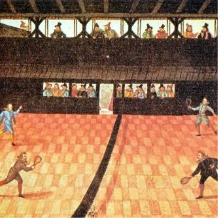
The story of Renaissance Hand and Ball Games and how it evolved into Tennis
Lily (Y11) explores the Renaissance origins of tennis in France, and how it has influenced the popular game we play today.
Le tennis est un sport extrêmement populaire en Angleterre, surtout parce que Wimbledon accueille l’un des quatre tournois du Grand Chelem – ‘Wimbledon Tennis’. Peut-être que tu sais un peu comment c’était avant – des raquettes en bois, des pantalons blancs et les jupes très longues. Peut-être que tu sais que ‘Wimbledon Tennis’ se déroulait à l’origine sur le terrain de sport de notre école. Mais savais-tu que le sport est issu d’un jeu populaire joué par les moines vers le douzième siècle ?
Jeu de paume, meaning ‘game of the hand/palm’, originated in France as a ball and court game, popular amongst French monks, in which you would hit a ball with your hand. Players soon began to wrap their hands for protection, evolving into the use of gloves. That, however, soon gave way to using wooden paddles, and eventually the invention of stringed rackets (although that was much later, in the 19th century).
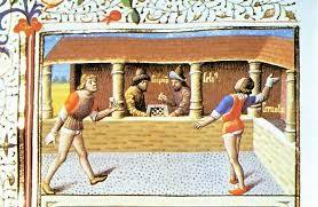
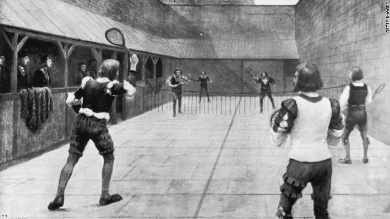
The French aristocracy shortly picked up the game, and it became known as a symbol of elite culture, as well as a display of skill. Although the game was initially played in marketplaces, play was soon moved indoors to long, narrow courts, avoiding disruption and accommodating for the growing popularity of the sport.
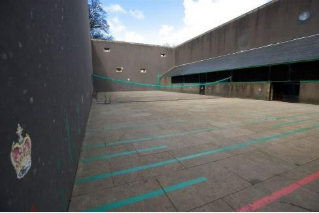
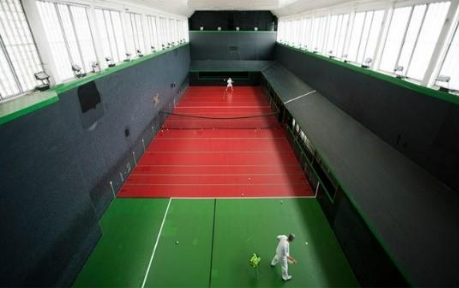
Did you know: the sloping walls featured in some modern real tennis courts symbolise the medieval marketplace walls. (See images below)
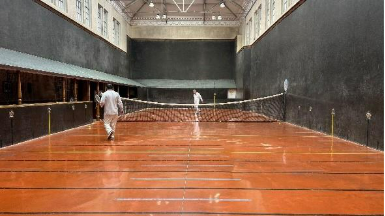
Once the game was popularized among the French nobility and monarchs, it began to spread across Europe, including England. You may have heard that Henry VIII played jeu de paume/real tennis (in the 15th and 16th centuries), and in fact, his real tennis court is still available for use at Hampton Court. At this time, wooden rackets with asymmetrical heads and solid, heavy balls were in use.
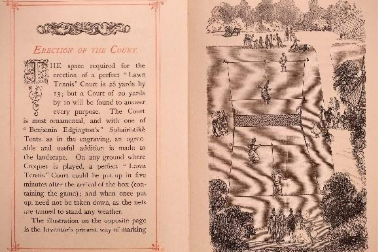
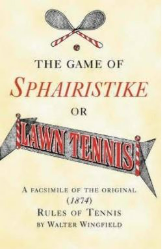
In the late 19th century, jeu de paume began to be referred to as “real tennis” in order to distinguish it from the newly invented game, lawn tennis. Major Walter Clopton Wingfield patented and published the first rules for lawn tennis in 1873-1874, adapting the indoor game of real tennis to an outdoor game, with a portable set of rules and equipment, making the game accessible for back-garden use. He called his patented game Sphairistiké, an ancient Greek word meaning “skill in playing at ball” or “the art of playing ball”, with his initial design being a roughly hourglass-shaped court, publishing the rules in a book he wrote in 1873 (see below).
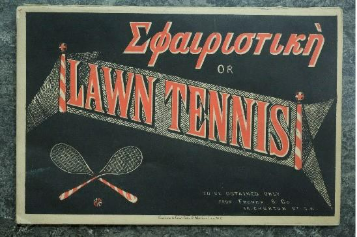
Did you know: the term “real” wasn’t to do with the sport’s royal or true nature, instead it was used to specify that real tennis was the original sport, and that lawn tennis came afterwards.
At around the same time, Englishman Major Harry Gem, alongside his friend Augurio Perera, a Spanish-born merchant, created a game called pelota, lawn rackets or lawn tennis, including a new set of rules for a rackets game.
While the layout of the courts and the rules of these versions of lawn tennis were later modified, the early inventions, as well as the inspiration from jeu de paume/real tennis were crucial to how quickly lawn tennis grew in popularity, becoming a social activity for the middle classes, ultimately leading to its adoption by the All England Croquet Club in 1875, with the first tennis tournament, a gentleman’s singles championship, hosted two years later, in 1877.
Did you know: It is believed that the name “tennis” came from the French imperative “tenez”, meaning “take!” or “receive!”, which was called out by the server to the opponent, to warn the opponent that the ball was about to be served.
As lawn tennis originated from sports well-known for being played by the upper class (e.g. Henry VIII with real tennis, the French nobility and monarchs with jeu de paume, etc.), immense importance was placed upon having proper etiquette, controlled behaviour and modest clothing, reflecting how tennis is typically held as a prestigious sport in our society today, showing the impactful inspiration the French origins of jeu de paume had on the game of tennis that we play in the 21st century.
Did you know: there is a theory that the word “love”, used in tennis to denote zero points, originates from the French word “l’oeuf”, meaning ‘egg’, due to the fact that the shape of an egg resembles the number zero (0). Therefore, when the game was popularised in England, it is believed that English speakers mistook the word “l’oeuf”, to be ‘love’.
Extra pictures:
A modern real tennis court: Tennis in 1910 – grasscourt:
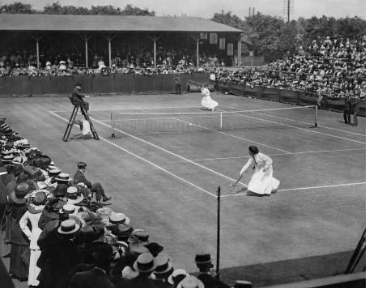
(Image on the right) Edith Johnson vs Dorothea Lambert Chambers in the 1910 Wimbledon tournament – fun fact: this took place at our sports ground on Nursery Road
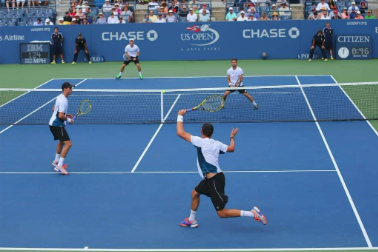
Tennis nowadays can be played on a variety of surfaces – below is an acrylic hard court: